


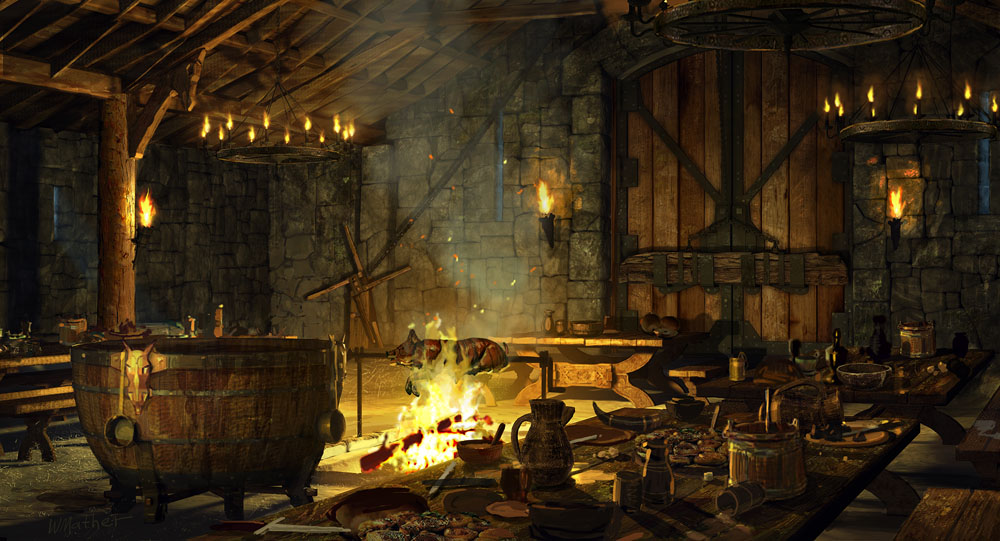

Beowulf is an anonymous alliterative Anglo-Saxon heroic poem, the greatest and longest surviving Old English poem (Alexander, 2005). The poem is written in unrhymed four-beat alliterative metre and tells of the great deeds and death of the Geat hero known as Beowulf (Slade, 2003).
According to Bloom (2008) the Anglo-Saxon poem may have been written at the beginning of the eighth century, or perhaps around the year 1000 – manuscript official date. Accordingly to Hollander and Kermode (1973), this Codex, MS. Cotton Vitellinus A.XV, is believed to be copied by two scribes from another version of an original composed much earlier. The manuscript is written in the classical Late West-Saxon dialect of Wessex, which had become the literary standard (Alexander, 2007, p.29).

By the time the story of Beowulf was composed, much of its material had been in circulation in oral narrative form during many years. Hollander and Kermode (1973) have drawn attention to the fact that this manuscript of the poem is not the first-original version, “there must have been earlier manuscript, perhaps transcribe in West Mercia or further north in Northumbria, where the poem may well have been composed” (p. 21). Unfortunately, the exact date and provenance of the text are uncertain, and its authorship unknown. According to Slade (2003) the poem’s purpose is unclear as well, and he suggests different options such as: a Christian allegory, a criticism of heroic culture, or even the mourning for the loss of heroic culture.
Although still an old pagan story, Hollander and Kermode (1973) indicate that Beowulf came to be told by a Christian poet (p. 24), since the Anglo-Saxon and Scandinavian people who settled in Britain, originally pagan, experienced a large-scale conversion to Christianity at the end of the sixth century (SparkNotes, 2003). Therefore, while being a story based in late medieval Anglo-Saxon times, we do not find included solely Pagan references – monsters, Wergild, Wyrd – but also some Christian influences: Cain’s progeny, battle between Good and Evil, etc. (Universitat de València, 2012). Finally, scholars still disagree whether “the social milieu of Beowulf is essentially Christian, secular, or mixed” (Gwara, 2009, p. 1); whereas, it is agreed that the poem allows a Christian perspective upon the heroic worlds (Alexander, 2005).
In conclusion, Beowulf is the oldest poem in the English language; hence everything written since then tends to stem to some extent from this poem. As Gwara (2009) points out, it can be considered that Beowulf showed uniqueness in length, structure, action, versification, and diction; the poem is so heterogeneous that it straddles every conceivable generic classification, as folktale, heroic verse, epic, elegy, saga, etc. “In other words, few native literary parallels can illuminate so distinctive a poem” (Gwara, 2009, p. 1). Thus, the Old English poem Beowulf is an excellent choice for this paper, due to its rich and interesting elements, themes, motifs and symbols. I will analyse its various characteristics, first by scrutinizing the different scholar’s opinions, then by providing my own conclusions based on academic evidences found.