19. Bibliography

Alchin, L. K. (n.d.). Courtly Love. Retrieved 22 May, 2013 from http://www.middle-ages.org.uk/courtly-love.htm

Anderson, J. J. (Ed.). (1995). Chaucer, The Canterbury Tales: a casebook. Basingstoke: Macmillan Press.

Artmitage, S. (Trans.). (2007). Sir Gawain and the Green Knight. London: Faber and Faber.

Borroff, M. (Trans.). (2011). The Gawain poet : complete works: Patience, Cleanness, Pearl, Saint Erkenwald, Sir Gawain and the Green Knight. New York: W.W. Norton & Co.

Chivalric romance. (2013). In Wikipedia. Retrieved May 22, 2013, from http://en.wikipedia.org/wiki/Romance_%28heroic_literature%29

Chivalry. (2013). In Wikipedia. Retrieved May 22, 2013, from http://en.wikipedia.org/wiki/Chivalry

Cooper, H. (1998). Introduction. In K. Harrison (Trans). Sir Gawain and the Green Knight (p. XXV). Oxford: Oxford University Press.

Courtesy (2013). In Wikipedia. Retrieved May 22, 2013, from http://en.wikipedia.org/wiki/Courtesy

Courtly love. (2013). In Wikipedia. Retrieved May 22, 2013, from http://en.wikipedia.org/wiki/Courtly_love

Gawain. (2013). In Wikipedia. Retrieved May 22, 2013, from http://en.wikipedia.org/wiki/Sir_Gawain

Gentry, F. G.(Ed.). (2009). Medieval and Renaissance Authors and Texts, Volume 4: Wisdom and Chivalry: Chaucer’s Knight’s Tale and Medieval Political Theory. Boston: Brill Academic Publishers.

Gordon, E. V. & Tolkien, J. R. R. (Eds.). (1967). Sir Gawain and the Green Knight (2nd. ed.). Oxford: Oxford University Press. 1967

Greenblatt, S. (Ed.). (2012). The Norton anthology of English literature, Volume A: The Middle Ages. (9th ed.). New York: W.W. Norton & Co.

Harrison, K. (Trans.). (1998). Sir Gawain and the Green Knight. Oxford: Oxford University Press.

Jessie Weston. (2013). In Wikipedia. Retrieved 22 May, 2013, from http://en.wikipedia.org/wiki/Jessie_L._Weston

Medieval literature. (2013). In Wikipedia. Retrieved 22 May, 2013, from http://en.wikipedia.org/wiki/Medieval_literature

Middle English literature. (2013). In Wikipedia. Retrieved 22 May, 2013, from http://en.wikipedia.org/wiki/Middle_English_literature

Old English literature. (2013). In Wikipedia. Retrieved 22 May, 2013, from http://en.wikipedia.org/wiki/Old_English_literature

Pope, R. (2001). How to study Chaucer. Basingstoke: Palgrave.

Rigby, S. H. (2009). Wisdom and chivalry: Chaucer’s Knight’s tale and medieval political theory. Boston: Brill Academic Publishers.

Schwartz, D. B. (2001). Backgrounds to Romance: Courtly Love. Retrieved May 22, 2013, from http://cla.calpoly.edu/~dschwart/engl513/courtly/courtly.htm

Sir Gawain and the Green Knight. (2013). In Wikipedia. Retrieved May 22, 2013, from http://en.wikipedia.org/wiki/Sir_Gawain_and_the_Green_Knight

Stone, B. (Trans.). (1974). Sir Gawain and the Green Knight (2nd ed.). London: Penguin Books.

The Canterbury Tales. (2013). In Wikipedia. Retrieved May 22, 2013, from http://en.wikipedia.org/wiki/Canterbury_Tales

The Knight’s Tale. (2013). In Wikipedia. Retrieved May 22, 2013, from http://en.wikipedia.org/wiki/The_Knight%27s_Tale

Tolkien, C. (1985). Sir Gawain and the Green Knight ; Pearl ; and Sir Orfeo (J.R.R. Tolkien Trans.). London: Unwin Paperbacks.

Universitat de València. (2012). An Interactive History of English Literature: Sir Gawain ad The Green Knight. Retrieved 21 May, 2013, from http://mural.uv.es/ihel/literature/me/gawain.html

Universitat de València. (2012). An Interactive History of English Literature: The Canterbury Tales. Retrieved 21 May, 2013, http://mural.uv.es/ihel/literature/chaucer/canterbury.html

Weston, J. L. (2013). Sir Gawain and the Green Knight. The Camelot Project. Retrieved 22 May, 2013, from http://www.lib.rochester.edu/CAMELOT/sggk.htm

Wetherbee, W. (2004). The Canterbury tales: Geoffrey Chaucer. Cambridge: Cambridge University Press.

Wheeler, L. K. (2013). Courtly Love. Retrieved 22 May, 2013 from http://web.cn.edu/kwheeler/courtly_love.html

General

18. Conclusion

Why did I do all this? After deciding that my choices would be connected to the early history of English literature – that is, Old English and Middle English Literature – the reading of the texts gave me multitude of ideas to present, again, the way I interpret the texts in this Second Paper as a 21sr century reader.

For this purpose, and as it can be observed throughout the Blog, my first purpose was to provide what I considered the more accurate academic evidences, in order to subsequently present my own vision of the texts ad their relationships, similarities and differences – primarily using a mixture of academic data with my own as done in my First Paper.

I reached the conclusion that The Knight’s Tale is an example of a chivalric romance, where the knights Palamon and Arcite exhibit nobility, courage, and respect for their lady – that is, they stand for the values of courtly love, whereas Beowulf represent the Germanic warrior code, and Sir Gawain symbolize the values of Chivalry.

Ultimately, the chivalric values derived from the Christian ethics, encouraging spiritual principles in a sinner world; the worlds of Sir Gawain and the Green Knight and The Knight’s Tale are governed are well-defined by this code of behaviour – represented by the actions of  the characters of Sir Gawain and Chaucer’s Knight in the General Prologue. However, it is clear that the tale shows a much more violent world than Sir Gawain and the Green Knight‘s – being Palamon and Arcite a much more destructive and old-fashioned version of a medieval chivalric knight.

In summary, we are witnesses of ‘courtly love‘ on Sir Gawain’s courteous behaviour while following the Christian medieval chivalric values; and also in Palamon and Arcite, being their behaviour more old-fashioned and violent, but equally noble, courageous and pure.

Regarding the rulers, we have to similar rulers, old Beowulf and Duke Theseus; a wise King Hrothgar who lacks heroic spirit; and finally a childish King Arthur, who is portrayed as a still young monarch, although too light-hearted and different from the well-known version of the mythological King Arthur.

General

17. The Rulers

Now, I would like to briefly comment on the similarities and differences between King Hrothgar, old Beowulf, King Arthur and Duke Theseus.

The central figure in The Knight’s Tale is Theseus, he embodies chivalric heroism in its highest form. The knight opens with a review of Theseus’ heroic exploits, reduced to occasions to praise of his hero (Wetherbee, 2004, p. 36). This is very similar to the situation we saw in Beowulf, who, over the course of the poem, passes from ambitious, fierce combatant, who travels afar to protect others (Greenblatt, 2012), into a prudent king, who must commit himself to guard his own people (Hollander and Kermode, 1973). Both represent bravery and loyalty as warriors, and rules and order as sovereigns.

Rigby (2009, p. 4). observes that Chaucer’s Knight judges Theseus as be a noble, wise, chivalric and heroic figure. He is thus seen as a ruler who seeks to establish harmony, order and unity:

(…) he [Theseus] loves and desires the common profit, abominating that which undermines the common good and hating the vice which is contrary to such good. He has the hope and hardiness which allow him to avoid the temptation of despair and which enable him to do good deeds without being over-ambitious in what he seeks to achieve. Having the virtue of fortitude, he is not excessively fearful, yet, as we shall see, is still cautious enough to take counsel on how to secure the safety of his realm. Whilst he is wrathful, seeking revenge against injustice, he also moderates this passion. (…) He takes delectation in the pleasures of the hunt and yet his pleasure is not so excessive as to detract from his duties as a ruler. Finally, whilst feeling sorrow, he sees that excessive sadness can paralyse our virtue and social life and so seeks to comfort others in order to abate their grief. (…) Nevertheless, in his ability to overcome and control his own passions and to exercise his reason for the common good, the Duke’s virtue is offered up to us as exemplary (Rigby, 2009, pp. 126-127).

On the one hand, Rigby (2009, p. 127) continues by observing that “Duke Theseus combined, as a man in his prime, the virtuous ‘manners’ of both the young and the old”.  Whereas, King Hrothgar in Beowulf is introduced as a good king, generous and firm, but old and lacking the true heroic spirit, who, having much to lose, seeks protection for his people. Obviously, Beowulf rather than Hrothgar is the ruler which more similarities shares with Chaucer’s Theseus.

On the other hand, King Arthur and Round Table Knights are portrayed as a boyish party in Sir Gawain and the Green Knight; e.g. as soon as the Christmas feasting begins, we learn that Arthur is too excited to eat, for “he was so lively in his youth, and a little boyish”. In fact, Arthur has a hard time sitting still, he’s so restless.

The King’s reaction to Sir Gawain’s adventure differs radically from Sir Gawain’s own. Gawain tells the court of Camelot what happened, and shows them the scar on his neck and the green girdle, ashamed. However, as opposed to expected, Arthur and his court laugh out loud. For Sir Gawain’s sake, all the knights and ladies take up the girdle as a symbol, establishing it as fashion rather than repentance or humility. There is something too light-hearted about Arthur’s response, which recalls the boyish, inexperienced court of the beginning. Gawain has clearly outgrown such an outlook, but Camelot essentially turns Sir Gawain’s mark of weakness into a fashion statement.

Ultimately, we have to similar rulers, old Beowulf and Duke Theseus; a wise King Hrothgar who lacks heroic spirit; and finally a childish King Arthur, who is portrayed as a still young monarch, although too light-hearted and different from the well-known version of the mythological King Arthur.


Themes , ,

16. Courtly love

A chivalric romance is a style of heroic prose and verse narrative which was popular in the aristocratic circles of High Medieval time; they were the narration of the fantastic adventures of a knight who goes on a quest (Wikipedia, 2013).

Courtly love is a literary genre where love is only practiced between a man and a woman of noble status – e.g. two knights and a member of the royal family in the case of The Knight’s Tale;  who represent the best and most ideal of their estate. The lovers cannot be married because this kind of love is ideal and such relationships did not exist in medieval times – convenience marriages were very common. This love is passionate and disciplined. In tale the author takes courtesy back to ancient paganGreek times (Universitat de València, 2012).

As mentioned, The Knight’s Tale is an example of a chivalric romance. On the one hand the knights demonstrate bravery, nobility and respect for their lady; on the other hand the lady displays modesty, elegance and fidelity. The latter being very important since both parts must avoid immoral behaviour.

The narrative still concern the deeds of brave warriors, but the Middle English knight (unlike the Old English thane) is motivated by love for his lady. Accordingly, women play an increasingly important and active role. (…) The knight serves his courtly lady  with the same obedience and loyalty which he owes to his liege lord. She is in complete control of the love relationship, while he owes her obedience and submission. The knight’s love for the lady inspires him to do great deeds, in order to be worthy of her love or to win her favor (Schwartz , 2011).

As it has been already stated, the courtly love relationship typically was not between husband and wife, since it was an idealized relationship which could not exist in medieval marriages. Dr. D. R. Schwartz (2011) observes that “in the middle ages, marriages amongst the nobility were typically based on practical and dynastic concerns rather than on love”. The ‘romance’ might be seen as a means of allowing knights and ladies to show their admiration regardless of their marital state (Alkin, n.d.).

Some scholars agree in that ‘courtly love’ had a sort of code with its own ‘rules’, similarly as the chivalric code had its own conducts of knightly behavior. As Dr. L. K. Wheeler (2013) states:

Courtly love was associated with: nobility, since no peasants can engage in “fine love”; secrecy; adultery, since often the one or both participants were married to another noble or trapped in an unloving marriage; and, paradoxically, with chastity, since the passion could never be consummated due to social circumstances, thus it was a “higher love” unsullied by selfish carnal desires.

Furthermore, Sir Gawain and the Green Knight could be viewed as a romance since recounts the adventures of an heroic knight who personify chivalry’s values, goes on a quest to face tests, and the story also involves the interest on a high rank lady. Nevertheless, this medieval romance focus not on love and sentiment, but on adventure (Wikipedia, 2013).

There are two test in the story, the first of them is the beheading game, which is the last to finish, and the second is the hostess temptation at Bertilak’s castle. The outcome of the beheading first test, and therefore Gawain’s life, depends on his conduct at the castle (Gordon and Tolkien, 1967, Introduction XIV).

When the wife of his host sets about trying to seduce him, he is anxious that he will not be able to maintain his sexual integrity or his duties to his host unless he breaches his courtesy to the lady (Cooper, 1998, Introduction XXV). Sir Gawain is referred in the story as ‘courteous’; he even receives the kisses of Lady Bertilak with discretion, “at once not wanting to insult her by refusing her advances and not wanting to betray the hospitality of her husband” (Wikipedia, 2013). However, he is finally proven fallible: “his faulty includes cowardice, because it was brought about by fear of death; and treachery, because it involved a breach of faith with the host to whom sir Gawain had pledged feudal allegiance” (Borroff, 2011, p. 191-192).

In summary, we are witnesses of ‘courtly love’ on Sir Gawain’s courteous behaviour while following the Christian medieval chivalric values; and also in Palamon and Arcite, being their behaviour more old-fashioned and violent, but equally noble, courageous and pure.

Themes , ,

15. The Chivalric Code

The Chivalric code is the traditional code of conduct associated with the medieval institution of knighthood (Wikipedia, 2013). Chivalry arose from an idealized German Warrior Code – as seen in Beowulf; and it was originally conceived of as an aristocratic society: Sir Gawain is part of the court, Palamon and Arcite are members of the Thebes royal family, and lastly Chaucer’s Knight is high ranked in society as well.

All knights were supposed to follow the chivalric code: generosity, chastity, courtesy, brotherhood and piety (Universitat de València, 2012). Hovewever, through time its meaning and qualities have been “refined to emphasise more ideals such as the knightly virtues of honour, courtly love, courtesy, and less martial aspects of the tradition” (Wikipedia, 2013). Hence, originally medieval knights were prepared and lived for warfare, nonetheless, the system acquired other demanours and attitudes according to the ‘new’ Christian values.

(..) though the poem does not tell a specifically Christian story, its hero [Sir Gawain] embodies a complex moral ideal defined only partly in Christian terms. Its emblem is a five-pointed star drawn in one continuous line, called by the poet the “Pentangle” and the “endless knot”. This ideal symbolizes the moral and spiritual perfection of its possessor, including such specifically Christian elements as reliance on the five joys of the virgin Mary for fortitude in battle, and trust in the five wounds suffered by Christ on the cross. In addition, the inner side of Gawain’s shield bears an image of the Virgin (Borroff, 2011, p. 189).

The games and tests in Sir Gawain and the Green Knight will try to test the knights’ virtues, and especially those of Sir Gawain (Universitat de València, 2012). Although Sir Gawain does not know it, what is being measured is the moral and Christian ideal of chivalry (Greenblatt, 2012, p. 184).

Regarding Palamon and Arcite, the general purpose of chivalry was to noble action, although reguarly conflicting values degenerated into violence – e.g. jousts and tournaments, which at times ended in the death of the loser. The Knight’s Tale shows how the two sworn-blood knights brotherhood turns into a violent action due to the presence of a woman, with both knights fighting each other to death in order to claim her. “Chivalry was in Chaucer’s day on the decline, and it is possible that The Knight’s Tale was intended to show its flaws” (Wikipedia, 2013).

Ultimately, the chivalric values derived from the Christian ethics, encouraging spiritual principles in a sinner world. In conclusion, the worlds of Sir Gawain and the Green Knight and The Knight’s Tale are governed by well-defined codes of behaviour; this code of chivalry is represented by the actions of  the characters of Sir Gawain and Chaucer’s Knight in the General Prologue. However, it is clear that the tale shows a much more violent world than Sir Gawain and the Green Knight‘s – being Palamon and Arcite a much more destructive and old-fashioned version of a medieval chivalric knight.

Themes , ,

14. Hero Differences

Even though there are a significant number of similarities between this works, Beowulf, Sir Gawain and the Green Knight, and The Canterbury Tales – focusing on the characters from Chaucer’s The Knight’s Tale and the Knight in the General Prologue; however, there exist inner immense dissimilarity. They are different types of heroes, each of them with their differences, representing the values of their culture. Furthermore, it is interesting that hundreds of years later, the definition of a hero is wholly exemplified in all of them.

The first and major difference is the way the main characters are portrayed: Beowulf, Sir Gawain, the Knight in Chaucer’s General Prologue and the characters in The Knight’s Tale, Palamon and Arcite. Beowulf is inhumane and fearless, which leads him to dangerous quests; while on the contrary Sir Gawain is more human – the poem frequently reiterates Gawain’s deep fears and anxieties. They both have true rigid morals yet Beowulf is arrogant, he lacks humility; Sir Gawain is always true and humble, his honour is his best value. Moreover, Palamon and Arcite, apart from being noble and young, they resemble Sir Gawain since they are equally valorous knights (Anderson, 1995, p. 125). Additionally, they may be classified as ‘courtly lovers‘ (Pope, 2001, p. 54). Regarding their narrator, Chaucer’s Knight is the example of the upper class: noble, humble, courageous and gentle -that is, a mixture between a warrior and a saint, very similar to Sir Gawain as well.

In his own way, each hero represents the values of his culture; they conveyed utterly different concepts of what a hero can be. Beowulf represents the Germanic warrior code: strength, courage, and loyalty. He displays his bravery in all stages of the epic; he embodies the qualities of a perfect hero in addition to being the bravest of all men. Sir Gawain and Chaucer’s characters – the Knight, Palamon and Arcite – represent courteysie and the chivalric code of the medieval period which also involves courage, loyalty, and physical prowess.

Whatever the circumstances, and whoever he deals with, Sir Gawain is always courteous, a term of complex meaning which includes most of the virtues recognized by medieval aristocratic Christian society as we see it in the poem. The courteous man is noble, religious, decent, graceful, eloquent, compassionate, humble, grave; he is capable of both love and chastity, frank in attitude but reserved in behaviour and aware of all the delicacies of personal relationship and public demeanour which go to make up the civilized life (Stone, 1974, pp. 19-20).

The knight who appears among the pilgrims in The Canterbury Tales, personifies fidelity and honour, has served worthily in “his lord’s war” and “has fought for our faith”. In conclusion, “the time-honoured ideal of knighthood, or chivalry, is explicitly emphasized” in Sir Gawain and Chaucer’s Knight (Borroff, 2011, p. 190). However, regarding Palamon and Arcite, a conflict between love and comradeship in the hearts of the two knights is the emotional focus of the story. It share the main concerns of medieval chivalry: tournaments, battles and romantic courtship. The main thing that distinguishes court romances is that “they present love in a particularly aristocratic and refined form sometimes called ‘courtly love’, and their violence is also of the highly ceremonial ‘chivalric’ sort” (Pope, 2001, p. 47).

Courtesy, and specially the courtesy of lovers, was part of the definition of the perfect knight. But the relationship of love and war is one-sided: honouring his lady confirms the knight’s courtesy, but it is most of all an excuse for the self-centered enterprise of demonstrating prowess. In practice, warfare remains the true test of chivalry, and courtesy is largely the stuff of courtly poetry (Wetherbee, 2004, p. 35).

Yet Sir Gawain and the Green Knight equally reflects its origin in the late 14th c., when the ideal of knighthood, based on the devoted loyalty of a mounted warrior to the feudal lord from whom he held land and for whom he fought, was slowly giving way to a les rooted military professionalism.

Furthermore, the heroes differ in the way they demonstrate their virtues.  Beowulf meets evil monsters which represent the antithesis of the warrior code:  Grendel, Grendel’s mother, and the Dragon. Sir Gawain’s test is not one against evil; it is one that tests his own integrity; he undergoes tests in order to prove his honesty, loyalty and chastity, and his allegiance to the chivalric code. Therefore, as the American scholar S. Greenblatt (2012, p. 184) points out, Sir Gawain is being measured against a moral and Christian ideal of chivalry.

We see him [Sir Gawain]at the crisis of the action forced to distinguish in scale of value the elements of his code, preserving his chastity, and his loyalty on the highest plane to his host; finally rejecting in fact absolute worldly ‘courtesy’, that is complete obedience to the will of the sovereign lady, rejecting it in favour of virtue (Tolkien, 1985, p. 4).

In terms of literature, undoubtedly this “break in the mathematical perfection of an ideal creature, inhuman in flawlessness, is a great improvement” (Tolkien, 1985, p. 5). We see the attempt to preserve the graces of ‘chivalry’ and the courtesies by mixing them with Christian morals. J. R. R. Tolkien states that the knight of the order of Chivalry “refuses adultery, places hatred of sin in the last resort above all other motives, and escapes from a temptation that attacks him in the guise of courtesy through grace obtained by prayer “(Tolkien, 1985, p. 5).

On the other hand, The Knight’s Tale is an example of a chivalric romance, or a tale of courtly love. In the tale, the knights Palamon and Arcite exhibit nobility, courage, and respect for their ladies fair, and the ladies exhibit elegance, modesty, and fidelity – that is, they stand for the values of courtly love, whereas Beowulf represent the Germanic warrior code, and Sir Gawain symbolize the values of Chivalry.

Themes , , ,

13. Introduction

An appropriate way to begin this Second Paper would be to explain the reasons that led to my two choices. While deciding on them, I wondered what pieces of literary work would be appropriate to analyse: something self-evidently related to my choice for my First Paper, Beowulf. Obviously, I could not choose two works of the same author since Beowulf is anonymous, thus, I decided that the most comprehensible choices would be in the Medieval period of literature – starting again from Old English Literature up to Middle English Literature.

This led me to choose another anonymous literary work, Sir Gawain and the Green Knight. This choice was perfect, since it gave me the opportunity to compare what I think are the most interesting points of the works: the diffrent types of heroes, Beowulf and Sir Gawain; and the different behaviour of the kings, King Arthur, Hrothgar and Beowulf.

Then I knew that my last choice should be a piece of work from Medieval times, hence I followed a chronological order until I finally come across Geofrrey Chaucer’s The Canterbury Tales. In fact, there was a tale in Chaucer’s work which claimed my attention: The Knight’s Tale. Although the action was set in the ancient Greece times, the portraying of the Knight by Chaucer in the General Prologue to the Canterbury Tales, and the depiction by this Knight as a narrator of the characters Palamon and Arcite, two knights,  offered me the opportunity two compare the three of them with Beowulf and Sir Gawain.

Furthemore, I found very interesting one character, Duke Theseus of Athenes, which could also be introduced to the previous comparison of rulers between King Arthur in Sir Gawain and the Green Knight, besides Hrothgar and Beowulf from Beowulf. Additionally, I became interested specially in the Chivalric code Sir Gawain and Chaucer’s Knight represent and the ‘courtly love‘ which although part of chivalry, symbolize the story of Palamon, Arcite and Emelye; therefore it seemed a good idea to focus also in those elements.

At this moment, I had already decided which two works else to compare with Beowulf, and also the two main points: the comparison of heroes, and the comparison of rulers; in addition, I wondered if I should also compare the Pagan and Christian elements of the three texts. However, after the reading of the two recently chosen literary works – which were not long readings – I concluded that I should not focus on that, because only Beowulf seemed really interesting for me in this aspect; Sir Gawain and the Green Knight and The Knight’s Tale were very easy to classify into Pagan, Christian or mixture.

A simple reading of the two texts in Library ‘Joan Reglà’ made me realize that: first, Sir Gawain and the Green Knight was a Christian work, with chivalric Christian values, in which just a few pagan elements were noticeable – e.g. some values of the Chivalric code which finally got attached to Christian ethics; and secondly that The Knight’s Tale was narrated by a character of Chaucer’s General Prologue to the Canterbury Tales markedly Christian and very similar to Sir Gawain, whereas his tale is set in ancient Greece, where all the characters are Pagans – even their knighthood code is old-fashioned and violent, i.e. pre-Christian. As I said, I finally concluded that I should not focus on the Pagan and Christian elements of the texts.

Then I started to look for information in the Humanities Library ‘Joan Reglà’ and focus on the heroes and kings of the literary pieces. I had to familiarize with the two new texts general background, thus I spent a lot of time gathering information. At that point, I had all I need to start to write and portray in this Second Paper the way I interpret the text as a 21st century reader.

General

12. Bibliography

Alexander, M. (Ed.). (2005). Beowulf: A Glossed Text. (rev. ed.) London: Penguin Books.

Alexander, M. (2007). A history of English literature. (2nd ed.). Basingstoke: Palgrave.

Baker, P. S. (Ed.). (2000). The Beowulf Reader. New York : Garland Publishing.

Benson, L. D. (2000). The Pagan Coloring of Beowulf. In Baker, P. S. (Ed.). The Beowulf Reader (pp. 35-50). New York : Garland Publishing.

Beowulf. (2013). In Wikipedia. Retrieved March 14, 2013, from http://en.wikipedia.org/wiki/Beowulf

Beowulf: A Modern Translation. (n.d.). In Auburn Enlarged City School District. Retrieved April 27, 2013, from http://hs.auburn.cnyric.org/teachers/michael_sullivan/ap/s0095617f?textonly=

Bloom, H. (Ed.). (2007). Bloom’s Modern Critical Interpretations: Beowulf. (rev. ed.) New York : Chelsea House, 2007

Bloom, H. (Ed.). (2008). Bloom’s Guides: Beowulf. New York : Bloom’s Literary Criticism.

Chambers, R. W. (1959). Beowulf: An Introduction to the Study of the Poem with a Discussion of the Stories of Offa and Finn (3rd ed.). Cambridge: Cambridge University Press.

Chivalry. (2013). In Wikipedia. Retrieved March 23, 2013, from http://en.wikipedia.org/wiki/Chivalry

Donaldson, E. T. (1966). Overview of the Poem. In Tuso, J. F. (Ed.) Beowulf: The Donaldson Translation, Backgrounds and Sources, Criticism (pp. 97-105). New York: W. W. Norton & Co.

Donoghue, D. (Ed.). (2002). Beowulf: A Verse Translation (S. Heaney Trans.). New York: W. W. Norton & Company.

English literature. (2013). In Wikipedia. Retrieved April 27, 2013, from http://en.wikipedia.org/wiki/English_literature

Epic poetry. (2013). In Wikipedia. Retrieved April 27, 2013, from http://en.wikipedia.org/wiki/Epic_poetry

Germanic hero. (2012). In Wikipedia. Retrieved April 28, 2013, from http://en.wikipedia.org/wiki/Germanic_hero

Germanic Heroic Age. (2013). In Wikipedia. Retrieved April 28, 2013, from http://en.wikipedia.org/wiki/Germanic_Heroic_Age

Greenblatt, S. (Ed.). (2012). The Norton anthology of English literature, Volume A: The Middle Ages. (9th ed.). New York: W.W. Norton & Co.

Gwara, S. (2009). Medieval and Renaissance Authors and Texts, Volume 2: Heroic Identity in the World of Beowulf. Boston: Brill Academic Publishers.

Heaney, S. (2002). Beowulf. In Donoghue, D. (Ed.). The Text of Beowulf: A Verse Translation (pp. 3-78. New York: W. W. Norton & Company.

Hero. (2013). In Wikipedia. Retrieved April 27, 2013, from http://en.wikipedia.org/wiki/Hero

Hill, T. D. (2002). The Christian Language and Theme in Beowulf. In Donoghue, D. (Ed.). Beowulf: A Verse Translation (pp. 197-211). New York: W. W. Norton & Company.

Hollander, J & Kermode, F. (Eds.). (1973). The Oxford anthology of English literature. New York: Oxford University Press.

Irving, E. B., Jr.(2007). Christian and Pagan Elements. In Bloom, H. (Ed.). Bloom’s Modern Critical Interpretations: Beowulf (pp. 121-138). New York : Chelsea House, 2007

Jack, G. (Ed.). (1997). Beowulf: A Student Edition. (rev. ed.). Oxford : Clarendon Press.

Klaeber, F. (Ed.). (1950). Beowulf and the Fight at Finnsburg (3rd ed.). Boston: D. C. Heath & Co.

Lerer, S. (2007). Inventing English: A Portable History of the Language. New York: Columbia University Press.

Mead hall. (2013). In Wikipedia. Retrieved April 27, 2013, from http://en.wikipedia.org/wiki/Mead_hall

Nowell Codex. (2013). In Wikipedia. Retrieved March 24, 2013, from http://en.wikipedia.org/wiki/Nowell_Codex

Orchard, A. (2007). A Critical Companion to Beowulf. Woodbridge: D. S. Brewer.

Patterson, L. (2009). Acts of Recognition: Essays on Medieval Culture. Notre Dame: University of Notre Dame Press.

Robinson, F. C. (1985). Beowulf and the Appositive Style. Knoxville: University of Tennessee Press.

Schrader, R. J. (2007). Succession and glory in Beowulf. In Bloom, H. (Ed.). Bloom’s Modern Critical Interpretations: Beowulf (pp. 21-34). New York : Chelsea House, 2007

Seamus Heaney. (2013). In Wikipedia. Retrieved April 27, 2013, from http://en.wikipedia.org/wiki/Seamus_Heaney

Shippey, T. A. (2008). Symbols in the World of the Poem. In Bloom, H. (Ed.). Bloom’s Guides: Beowulf (pp. 62-66). New York : Bloom’s Literary Criticism.

Slade, B. (2003). An Introduction to the Structure & Making of the Old English poem known as Beowulf or the Beowulf and the Beowulf-codex of the British Museum MS Cotton Vitellius A.xv. Retrieved March 14, 2003, from http://www.heorot.dk/beowulf-vorwort.html

Staver, R. J. (2005). A Companion to Beowulf. Westport: Greenwood Press.

The Dragon (Beowulf). (2013). In Wikipedia. Retrieved April 27, 2013, from http://en.wikipedia.org/wiki/The_Dragon_%28Beowulf%29

Tolkien, J. R. R. (2002). Beowulf: The Monsters and the Critics. In Donoghue, D. (Ed.). Beowulf: A Verse Translation (pp. 103-130). New York: W. W. Norton & Company.

Tuso, F. J. (Ed.). (1966). Beowulf: The Donaldson Translation Backgrounds and Sources, Criticism. New York: W. W. Norton & Co.

Universitat de València. (2012). An Interactive History of English Literature: Beowulf. Retrieved 16 March, 2013, from http://mural.uv.es/ihel/literature/oe/beo.html

Webster, L. (2002). Archaeology and Beowulf. In Donoghue, D. (Ed.). Beowulf: A Verse Translation (pp. 212-236). New York: W. W. Norton & Company.

Williams, D. (2008). Cain’s Progeny. In Bloom, H. (Ed.). Bloom’s Guides: Beowulf (pp. 69-72). New York : Bloom’s Literary Criticism.

Zirk, J. (2011). Beowulf: An Epic Hero. Retrieved April 28, 2013, from http://www.literature-study-online.com/essays/beowulf.html

General

11. Conclusion

After deciding that my choice would be connected to the early history of English literature – that is, Old English Literature – the reading of Beowulf raised a multitude of questions. And, that was the moment that really triggered me to find answers to the doubts I had.

As it can be observed throughout the Blog, my first purpose was to provide what I considered the more accurate academic evidences regarding the poem in direct relation to my own interpretation of the epic. My vision of the text may be different from the wide range of expert opinions, therefore I will use a mixture of academic data with my own opinion in order to reflect my personal vision. Thus, I can conclude that my aim in this section, and the final goal of the Blog, is to present the way I interpret the text as a 21st century reader.

In my confusion, I decided that the religious interpretation of the poem would be one of the points to analyse and to discuss. There were numerous Christian and Pagan examples, but I did not want to be too picky, thus I chose those that really struck me as representative of both visions. I understood from the text that, at some point, Beowulf may have been an entirely pagan – oral – text, but as the society gradually became Christianized, the poet presented a mixture of traditional Germanic Pagan and the recent Christian values.

Obviously, from a Christian point of view, I could not help thinking about what was right or wrong in the poem. Firstly, the Geat hero Beowulf represents Good, and fights everything that challenges peace and order; whereas his supernatural enemies represent the Evil that endangers society. I strongly agree with J. R. R. Tolkien’s point of view, when he stressed upon the importance of the monsters as an antithesis of the hero. Finally, Good triumphs over Evil, for what it seems my impression of the poem was not mistaken at all!

In particular, the place that represented the challenged order and peace is the Mead-hall. Concerning this, I wanted to pay attention to the place Grendel the monster hated so much and what it represented. The Mead-hall was a place where warriors were safe, and ate, drank and sang – a place where they gatherd in the presence of their lord to boast and tell stories.

Secondly, in relation to the discussion about what was right and wrong in that time – the plot is set in the 5th century – I also paid attention to the behaviours within the Germanic society itself. Everybody believed that to risk their lives to gain glory was the correct action; it was also a world where you were morally obliged to avenge your kinsmen in order to protect your status. Definitely, this seems a very interesting issue since current society behaves in an opposite way, nobody risks his life in a foolish way or takes revenge on someone – or at least it is not ethically permitted.

Another essential theme would be the importance of establishing identity: the way they had to rely on their ancestors, as well as the way they had to perform heroic deeds in order to achieve some status in society. Moreover, the poem portrays a code which indicates that immortality is only possible if you had a glorious life worth to be remembered and sang.

However, the Germanic Heroic Code had a set of values which reached today’s society, i.e. courage is still a virtue, while cowardice is shameful. Indeed, that collection of values change over the course of the poem: Beowulf passes from ambitious, fierce combatant, who travels afar looking for glory and adventures, into a prudent king, who must commit himself to guard his own people. That is, he changes from youth to old age, from warrior to king. He first travelled to Heorot to kill Grendel in order to acquire glory, but when he fights the Dragon he is protecting his people as well as his reputation. In this sense, present day society behave more in a prudent way, were wisdom is more valued than courage or strength.

Ultimately, my interpretation of the poem is that it was an oral pagan story which became finally Christianised. It also represents the struggles between Good and Evil, hero and monsters. It portrays a very different society from today’s – revenge, risk your life for glory – but there are some elements which have not change, i.e. what we understand for a “hero” and what it represents.

General

10. The Importance of Mead-Halls

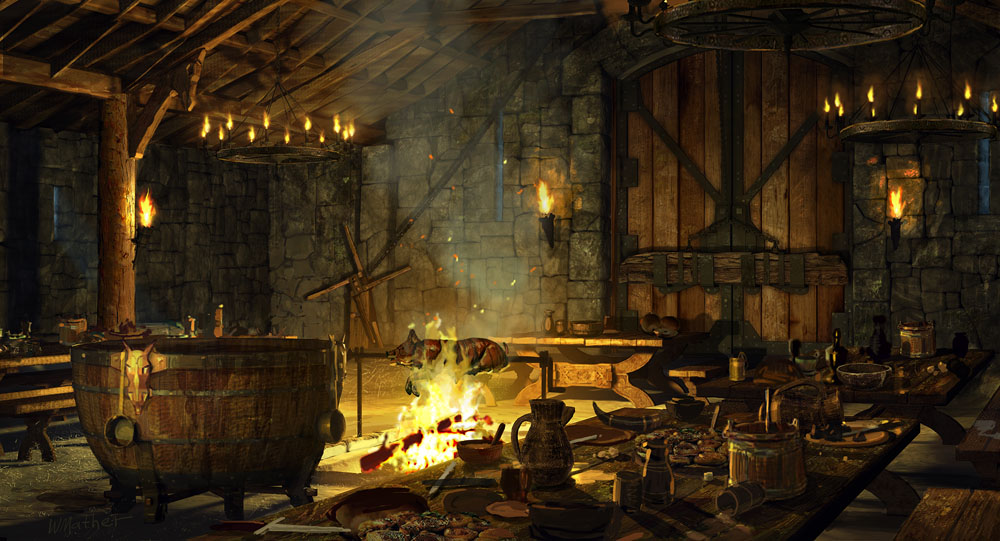
The Mead-Hall as a symbol of good and order, the good life, were warriors are safe, and eat, drink and sing (Universitat de València, 2012). The feast is a formal celebration marked by ceremonial gift-giving (Staver, 2005). Mead-halls such as Heorot in Beowulf were places where warriors would gather in the presence of their lord to boast and tell stories.

Then the due time arrived

for Halfdane’s son to proceed to the hall.

The king himself would sit down to feast.

No group ever gathered in greater numbers

or better order around the ring-giver.

The benches filled with famous men

who fell to with relish; round upon round

of mead was passed; those powerful kinsmen,

Hrothgar and Hrothulf, were in high spirits

in the raftered hall. Inside Heorot

there was nothing but friendship. The Shielding nation

was not yet familiar with feud and betrayal. (Heaney, 2002,

lines 1007-1018)

It represented a safe place for warriors returning from battle, where traditions were preserved, loyalty was rewarded and reputations were spread. The scholar T. Shippey (2008) highlights the rich variety of names with halls are addressed through the poem:

For drinking in (‘winehall’, ‘beerhall’, ‘meadhall’); they are filled with people (‘guesthall’, ‘retainer-hall’); in them worth is recognized (‘gold-hall’, ‘gifthall’, ‘ringhall’). It is this ‘loud merriment in hall’ which Grendel hears and hates from the beginning, while Hrothgar’s poet sings ‘clear in Heorot’ on every one of the three night Beowulf spends there. (pp. 64-65)

Mead-halls offered protection and peace, since the world portrayed in the Anglo-Saxon poem is set in a dangerous time – the idea of the hall as a place of joy and security until threatened by external forces of evil, plays a major part in the poem (Webster, 2002). The hall equals happiness which in turn equals light; whereas monsters are creatures of the night, ‘shadow-walkers’, ‘lurkers in darkness’, things which have to be under cover by dawn (Shippey, 2008).

In the mead-halls like Heorot, banquets represent the restoration of order and harmony in society (Universitat de València, 2012). After the fight with Grendel, the servants of Hrothgar mop up the blood, cover the splintered pillars, repair the benches, and sand the claw-marks off the walls before covering them with tapestries (Staver, 2005, p. 58). The rebuilding of the damaged mead-hall symbolizes the rebirth of the community. In addition, banquets have ceremonial functions as well, such as the election of new rulers, the forge of marriage alliances and war-related decisions. Hollander and Kermode find feasts to be chosen as a time for making such statements because “the heart is then open and exalted” (1973, p. 24).

Motifs ,