



After deciding that my choice would be connected to the early history of English literature – that is, Old English Literature – the reading of Beowulf raised a multitude of questions. And, that was the moment that really triggered me to find answers to the doubts I had.
As it can be observed throughout the Blog, my first purpose was to provide what I considered the more accurate academic evidences regarding the poem in direct relation to my own interpretation of the epic. My vision of the text may be different from the wide range of expert opinions, therefore I will use a mixture of academic data with my own opinion in order to reflect my personal vision. Thus, I can conclude that my aim in this section, and the final goal of the Blog, is to present the way I interpret the text as a 21st century reader.
In my confusion, I decided that the religious interpretation of the poem would be one of the points to analyse and to discuss. There were numerous Christian and Pagan examples, but I did not want to be too picky, thus I chose those that really struck me as representative of both visions. I understood from the text that, at some point, Beowulf may have been an entirely pagan – oral – text, but as the society gradually became Christianized, the poet presented a mixture of traditional Germanic Pagan and the recent Christian values.
Obviously, from a Christian point of view, I could not help thinking about what was right or wrong in the poem. Firstly, the Geat hero Beowulf represents Good, and fights everything that challenges peace and order; whereas his supernatural enemies represent the Evil that endangers society. I strongly agree with J. R. R. Tolkien’s point of view, when he stressed upon the importance of the monsters as an antithesis of the hero. Finally, Good triumphs over Evil, for what it seems my impression of the poem was not mistaken at all!
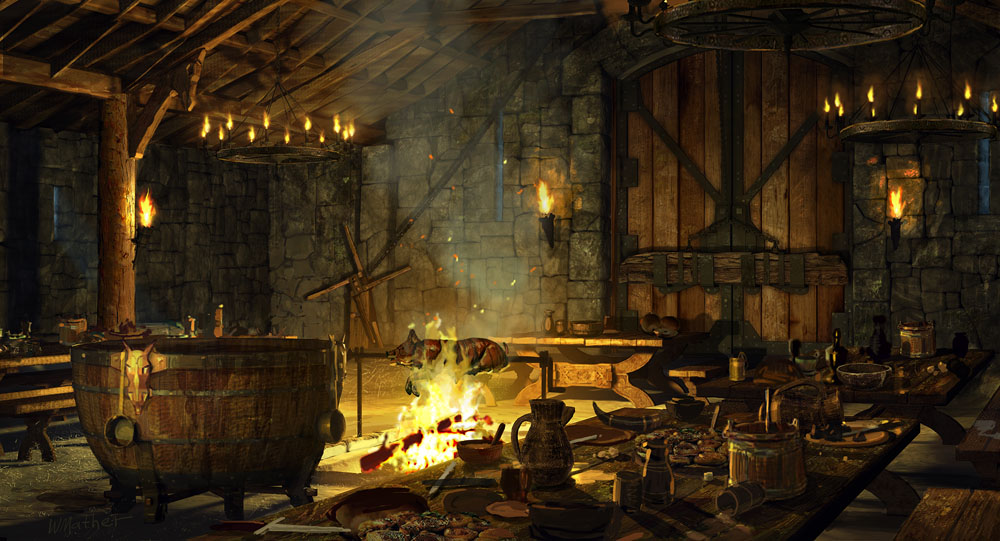
In particular, the place that represented the challenged order and peace is the Mead-hall. Concerning this, I wanted to pay attention to the place Grendel the monster hated so much and what it represented. The Mead-hall was a place where warriors were safe, and ate, drank and sang – a place where they gatherd in the presence of their lord to boast and tell stories.
Secondly, in relation to the discussion about what was right and wrong in that time – the plot is set in the 5th century – I also paid attention to the behaviours within the Germanic society itself. Everybody believed that to risk their lives to gain glory was the correct action; it was also a world where you were morally obliged to avenge your kinsmen in order to protect your status. Definitely, this seems a very interesting issue since current society behaves in an opposite way, nobody risks his life in a foolish way or takes revenge on someone – or at least it is not ethically permitted.
Another essential theme would be the importance of establishing identity: the way they had to rely on their ancestors, as well as the way they had to perform heroic deeds in order to achieve some status in society. Moreover, the poem portrays a code which indicates that immortality is only possible if you had a glorious life worth to be remembered and sang.
However, the Germanic Heroic Code had a set of values which reached today’s society, i.e. courage is still a virtue, while cowardice is shameful. Indeed, that collection of values change over the course of the poem: Beowulf passes from ambitious, fierce combatant, who travels afar looking for glory and adventures, into a prudent king, who must commit himself to guard his own people. That is, he changes from youth to old age, from warrior to king. He first travelled to Heorot to kill Grendel in order to acquire glory, but when he fights the Dragon he is protecting his people as well as his reputation. In this sense, present day society behave more in a prudent way, were wisdom is more valued than courage or strength.
Ultimately, my interpretation of the poem is that it was an oral pagan story which became finally Christianised. It also represents the struggles between Good and Evil, hero and monsters. It portrays a very different society from today’s – revenge, risk your life for glory – but there are some elements which have not change, i.e. what we understand for a “hero” and what it represents.