Alchin, L. K. (n.d.). Courtly Love. Retrieved 22 May, 2013 from http://www.middle-ages.org.uk/courtly-love.htm Anderson, J. J. (Ed.). (1995). Chaucer, The Canterbury Tales: a casebook. Basingstoke: Macmillan Press. Artmitage, S. [..]
Why did I do all this? After deciding that my choices would be connected to the early history of English literature – that is, Old English and Middle [..]
Now, I would like to briefly comment on the similarities and differences between King Hrothgar, old Beowulf, King Arthur and Duke Theseus. The central figure in The Knight’s [..]
A chivalric romance is a style of heroic prose and verse narrative which was popular in the aristocratic circles of High Medieval time; they were the narration of [..]
The Chivalric code is the traditional code of conduct associated with the medieval institution of knighthood (Wikipedia, 2013). Chivalry arose from an idealized German Warrior Code – as [..]
Even though there are a significant number of similarities between this works, Beowulf, Sir Gawain and the Green Knight, and The Canterbury Tales – focusing on the characters [..]
An appropriate way to begin this Second Paper would be to explain the reasons that led to my two choices. While deciding on them, I wondered what pieces [..]
Alexander, M. (Ed.). (2005). Beowulf: A Glossed Text. (rev. ed.) London: Penguin Books. Alexander, M. (2007). A history of English literature. (2nd ed.). Basingstoke: Palgrave. Baker, P. S. [..]
After deciding that my choice would be connected to the early history of English literature – that is, Old English Literature – the reading of Beowulf raised a [..]
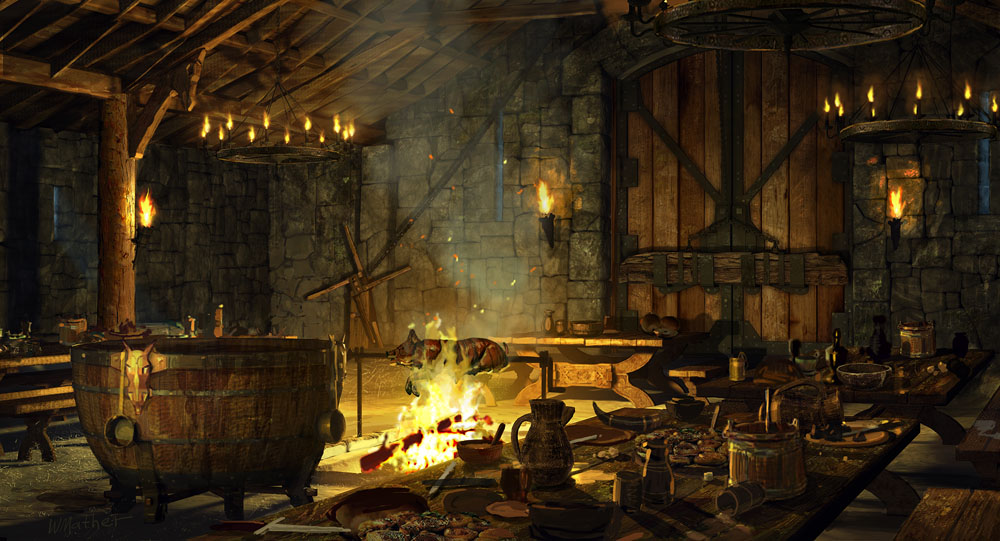
The Mead-Hall as a symbol of good and order, the good life, were warriors are safe, and eat, drink and sing (Universitat de València, 2012). The feast is [..]
The heroic world portrayed is violent, but the poem shows not just the glory but also the bonds of family honour and the duty of vengeance (Alexander, 2007, p. 30). The rules of the blood feud recognised that all players were of equal moral stature, and that every man should be held accountable for his actions (Staver, 2005).
The American scholar S. Greenblatt points out that the relationship between kinsmen was of great importance, to the extent that “if one of them had been slain, a man had a moral obligation either to kill the slayer or to exact the payment of Wergild (man-price) in compensation” (2012, p. 38). Greenblatt continues by stating that the real goal of the Wergild was to do what is right rather than obtaining wealth. In addition, the failure to take revenge was considered shameful; what can be noticed in Hrothgar’s shame over the murders committed by Grendel, since he was unable to take vengeance on him.
“Wise sir, do not grieve. It is always better
to avenge dear ones than to indulge in mourning.
For every one of us, living in this world
means waiting for our end. Let whoever can
win glory before death. When a warrior is gone,
that will be his best and only bulwark (…) (Heaney, 2002, lines 1384–1389)
In conclusion, “the heroic code involves obligations to lord, family and to guest, and the Beowulf poem brings these obligations into tension, with tragic potential” (Alexander, 2007, p. 31). Vengeance is the best comfort after a murder makes a great deal of sense in a culture of feud; paying the Wergilg meant settling a feud without any vengeance (Staver, 2005).
In the epic poem, the hero must fight against ogres, demons, dragons and strange monsters. These monsters are always linked to the evil, and sometimes have a biblical sense (Universitat de València, 2012). J. R. R. Tolkien stressed the importance of the monsters and their relation to “the evil side of the heroic life”, which he characterized as malice, greed, and destruction (Patterson, 2009, p. 158).
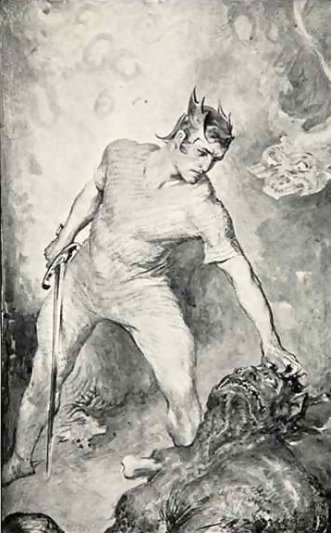
Since Grendel is descended from the biblical figure Cain, it represents evil from a Christian perspective. Besides, the ogre has been believed to represent the evil also in Germanic society (Tolkien, 2002). As it is clearly seen in the text, Beowulf’s fight with Grendel evokes the importance of reputation as a means to gain fame; whereas his subsequent encounter with Grendel’s mother evokes the importance of vengeance (Staver, 2005).
” (…) Then my moment came in the combat and I struck
the dwellers in that den. Next thing the damascened
sword blade melted; it bloated and it burned
in their rushing blood. I have wrested the hilt
from the enemies’ hand, avenged the evil
done to the Danes; it is what was due (…)” (Heaney, 2002, lines 1665-1670)
In addition, the figure of the dragon, represents the force of evil and sin that challenges what the hero represents in the Germanic Pagan world (Jack, 1997). Beowulf’s final epic battle with the dragon evokes a heroic approach to Wyrd, or fate, as Death’s second self. Even though the Geat hero recognizes he will not survive the clash, he bravely embraces his duty to protect his people, sacrificing his life to save them (Wikipedia, 2013).
(…) After many trials,
he was destined to face the end of his days
in this mortal world; as was the dragon,
for all his long leasehold on the treasure (…) (Heaney, 2002,
As Beowulf is essentially a record of heroic deeds, the concept of identity is clearly central to the poem. The two principal components of this concept, as portrayed in the Germanic pagan warrior culture of the poem, are: ancestral heritage and individual reputation. One’s identity was constituted by their ancestors and great deeds (Universitat de València, 2012).
Ancestral lineage was really important in those times, to the extent that men were respected depending on the glorious or unsuccessful situations in which they or their families might have been involved (Alexander, 2007). Regarding the importance of glory in Germanic pagan society, professor R. J.Schrader states:
The celebration of glory has such emphasis because human praise is the highest goal of the pagan characters, providing justification for individuals and a collective heaven for nations in a world where nearly all the apparent motion leads to dead ends. (2007, p. 21)
Characters in the poem are unable to talk about their identity or even introduce themselves without referring to family lineage (Universitat de València, 2012). Family reputation often correlates to the character’s place in society – even Grendel is presented as a seed of a past figure, a descendant of Cain, whose bloodline is cursed. On the contrary, Beowulf stands as a noble warrior and revered being who has come from a great line of Geat royalty, which automatically attributes him an admirable reputation, whether he had performed great deeds or not. This is indicated in Beowulf’s own words:
“We belong by birth to the Geat people
and owe allegiance to Lord Hygelac.
In his day, my father was a famous man,
a noble warrior-lord named Ecgtheow.
He outlasted man a long winter
and went on his way. All over the world
men wise in counsel continue to remember him (…)” (Heaney,
2002, lines 260-266)
Given this evidence, it can be seen that the characters take pride in ancestors who have acted valiantly, and they attempt to live up to the same standards. Therefore, a good reputation and victories are necessary to augment and consolidate the high standards of one’s ancestry. Besides, it is also a way to augment the reputation of the individual himself, since the character is also judged in society by his great deeds. The characters in Beowulf are defined by their status. Their status was in form of their fame and accomplishments.
On this basis, it may be inferred that the characters, especially warriors, were expected to boast about their past victories, so that people knew how to treat them (Universitat de València, 2012).
Boasting, a common feature of epic poetry, allows the hero to recount his exploits in order to show that he has already won fame and intends to seek it again. In Beowulf, boasting speeches are presented as a valid way to assert one’s position in society – also determined through one’s reputation.
Beowulf’s speech shocks a modern reader since modern civilization values modesty, so that we may all live peacefully together without making others feel inferior; those who have done great deeds are expected to downplay them and emphasize the group effort involved. However, Beowulf does the opposite: he emphasizes that he does not need help when he does great deeds. He boasts that he has fought with sea monsters at night and also states his intention to fight Grendel without weapons. In Beowulf’s time, this behaviour was clearly acceptable, as long as it is honest (Staver, 2005, p. 40).
Another example of Beowulf’s boasting is his speech to Geatland, in which he claims he is the only warrior brave enough to defeat the dragon.
Beowulf spoke, made a formal boast
for the last time: “I risked my life
often when I was young. Now I am old.
but as a king of the people I shall pursue this fight
for the glory of winning, if the evil one will only
abandon his earth-forth and face me in the open.”
(…)
“Men-at-arms, remain here on the barrow,
safe in your armor, to see which one of us
is better in the end at bearing wounds
in a deadly fray. This fight is not yours,
nor is it up to any man except me
to measure his strength against the monster
or to prove his worth. I shall win the gold
by my courage, or else mortal combat,
doom of battle, will bear your lord away.” (Heaney, 2002, lines
2510-2537)
Ultimately, in the Scandinavian tradition the fate of every character is death (Universitat de València, 2012). This is stated by Hollander and Kermode (1973), “A Germanic hero’s fulfillment is not reached in victory alone, but in unflinching courage in all circumstances (…) A glorious death is the only fitting close to a glorious life” (p. 27). It is clear therefore that, since the Germanic pagan warrior culture portrayed in the Anglo- Saxon poem seems not to have a concept of the afterlife, long-lasting fame is seen as a way to gain immortality through songs and stories. Thus, it could be concluded that reputation is the single quality that endures after death, it confirms the value of a heroic life.
Over the course of the poem, we witness how Beowulf passes from ambitious, fierce combatant, who travels afar to protect others (Greenblatt, 2012), into a prudent king, who must commit himself to guard his own people (Hollander and Kermode, 1973). Following the academic Michael Alexander: “The origin of Beowulf’s life-story is transmuted by the poem into a distinctly social ideal of the good young hero and the wise old king” (2007, p. 30).
Germanic kings and chieftains had to be generous to their followers and not arbitrary or cruel to their people (Staver, 2005, p. 13). Staver observes that the first duty of a Germanic king was to give gifts wisely: from the loot he handed out rewards in accordance with each man’s effort and standing (p. 58). The narrator describes a good king by saying, that a good king has thanes that would respect him and obey him.
As it has been already commented, the most valued characteristics in the Germanic heroic code of the poem, regarding warriors and rulers, are: courage, strength and fortitude in the former; wisdom, hospitality and generosity in the latter. The following lines by Hrothgar, as advice to Beowulf, show how the King possesses some of these qualities:
“O flower of warriors, beware of that trap.
Choose, dear Beowulf, the better part,
eternal rewards. Do not give way to pride.
For a brief while your strength is in bloom
but it fades quickly; and soon there will follow
illness or the sword to lay you low,
or a sudden fire or surge of water
or jabbing blade or javelin from the air
or repellent age. Your piercing eye
will dim and darken; and death will arrive,
dear warrior, to sweep you away.” (Heaney, 2002, lines
1758–1768)
The difference between these two sets of values manifests itself early in the outlooks of Beowulf and King Hrothgar. Hrothgar is introduced as a good king, generous and firm, but old and lacking the true heroic spirit, who, having much to lose, seeks protection for his people; whereas Beowulf is portrayed as a warrior who, having nothing to lose, desires personal glory, and finally dies in his moment of triumph over the enemy of his people (Hollander and Kermode, 1973, p. 27). The Anglo-Saxons believed that the only afterlife consisted of being remembered in songs or stories. In being remembered forever Beowulf would live on (Zirk, 2011).
In a time that values the individual, we can understand the Beowulf poet’s emphasis on the young man who challenges himself to take risks that no one has yet been able to handle. We can understand the changing circumstances for an aging hero who chooses to face a new monster, and probable death, to protect his people (Staver, 2005).
The Anglo-Saxon poem illustrates the Germanic heroic code. The Germans are a warrior race, setting courage above all other virtues, finding their deepest shame in cowardice (Hollander and Kermode, 1973, p. 23). The first way he shows Anglo-Saxon beliefs is through his bravery. This is one of the most valued characteristics in Anglo-Saxon society and those who show bravery are more honoured than the rest (Zirk, 2011).
This Germanic hero is always a warrior, concerned both with his reputation and fame, his death usually brings destruction and his goal is frequently revenge (Wikipedia, 2013). Beowulf is a prime example of an Anglo-Saxon epic hero because he showed bravery, loyalty, friendship, and the Anglo-Saxon idea of afterlife (Zirk, 2011). Beowulf is proud he never betrayed such code:
“(…) For fifty years
I ruled this nation. No king
of any neighbouring clan would dare
face me with troops, none had the power
to intimidate me. I took what came,
cared for and stood by things in my keeping,
never fomented quarrels, never
swore to a lie. All this consoles me,
doomed as I am and sickening for death;
because of my right ways, the Ruler of mankind
need never blame me when the breath leaves my body
for murder of kinsmen (…)” (Heaney, 2002, lines 2732-2743)
However, this warrior code is often in tension with the values of medieval Christianity. For example, the poem portrays a code which maintains that glory and immortality is gained during life through deeds (Irving, 2007), which is in direct opposition to the Christian belief that glory lies in the afterlife (Zirk, 2011). Nevertheless, there exist some similarities to the Christian Chivalric Code – the traditional code of conduct associated with the medieval institution of knighthood (Wikipedia, 2013).
Beowulf represents Good, and fights everything that challenges the peace of the characters; whereas Grendel, his mother and the dragon represent the chaos that endangers the original tranquillity of the story (Universitat de València, 2012). The philologist Frederick Klaeber (1950) assesses that “Beowulf rose to the rank of a truly ideal hero, and his contests were viewed in the light of a struggle between the powers of good and evil.” (p. 118).
According to the German philologist, and as it has been said in the Pagan and Christian Elements post on this blog, the main theme of the poem in its complete form could be seen as Christian in the sense of Good versus Evil – the main character Beowulf as a Jesus-like savior (Klaeber, 1950), who gives his life for his people, whereas Grendel is described as a descendant of Cain, who mirrors jealous Satan (Orchard, 2007). In this description of Heorot after Grendel’s massacres, King Hrothgar explains the evil consecuences of the monster’s actions to Beowulf:
“Time and again, when the goblets passed
and seasoned fighters got flushed with beer
they would pledge themselves to protect Heorot
and wait for Grendel with their whetted swords.
But when the dawn broke and day crept in
over each empty, blood-spattered bench,
the floor of the mead-hall where they had feasted
would be slick with slaughter. And so they died,
faithful retainers, and my following dwindled.
now take your place at the table, relish
the triumph of heroes to your heart’s content.” (Heaney, 2002,
The Anglo-Saxon poem Beowulf was written during a period in which the Anglo-Saxons had been converted from their worship of Germanic Pagan deities to the Christianity (Greenblatt, 2012, p. 37). Thus, it harbours several Pagan and Christian elements: the battle between Good and Evil, monsters, gore descriptions, the duty of revenge, Wyrd and Providence, etc. The American critic H. Bloom states that Beowulf is generally judged to be a Christian poem on a Germanic hero” (2007, p. 1). Following this statement, it is now widely believed that Beowulf is the work of a talented Christian poet, who mixes “the inheritance of Germanic Pagan myth and Christian doctrine” (Lerer, 2007, p.25). Besides this, according to M. Alexander (2005) the copying of the text by two monks might have been the major cause of the Christianization of the original oral poem.
On one hand, the main theme of the poem in its complete form could be seen as Christian in the sense of Good versus Evil. The philologist F. Klaeber observes that “in recounting the life and portraying the character of the exemplary leader [Beowulf]… he [the poet] was almost inevitably reminded of the person of the Savior” (1950, p. 121). Therefore, Beowulf can be seen as a Jesus-like saviour, who gives his life for his people, whereas Grendel is described as a descendant of Cain, fallen from grace through sin. He mirrors Satan because he lives in a kind of underworld such as Hell (Staver, 2005), and is jealous of the joy and happiness in Heorot, similarly as Satan is jealous of the happiness and joy Adam and Eve have in the Garden of Eden (Orchard, 2007). This is shown in the following lines:
So times were pleasant for the people there
until finally one, a fiend out of hell,
began to work his evil in the world.
Grendel was the name of this grim demon
haunting the marches, marauding round the heath
and the desolate fens; he had dwelt for a time
in misery among the banished monsters,
Cain’s clan, whom the Creator had outlawed
and condemned as outcasts. For the killing of Abel
the Eternal Lord had exacted a price:
Cain got no good from committing that murder
because the Almighty made him anathema,
and out of the course of his exile there sprang
ogres and elves ad evil phantoms
and the giants too who strove with God
time and again until He gave them their reward. (Heaney, 2002, lines 99-114)
On this basis, it may be assumed that Beowulf is a Christian poem since many parts of it would be only comprehensible to a Christian audience, and also because it is believed to be written by a Christian poet (Hollander and Kermode, 1973, p. 26).
On the other hand, references to Pagan elements might be found in the text; such as the figure of the dragon – a very common theme in Germanic Pagan stories (Jack, 1997), the existence of monsters, Beowulf’s and Grendel’s superhuman strength (Tolkien, 2002), the extremely gore description of battles and deaths (Universitat de València, 2012), or Beowulf’s cremation rite as funeral (Irving, 2007). The latter can be seen in the verses below:
The Geat people built a pyre for Beowulf,
stacked and decked it until it stood foursquare,
hung with helmets, heavy war-shields
and shinning armor, just as he had ordered.
Then his warriors laid him in the middle of it,
mourning a lord far-farmed and beloved.
On a height they kindled the hugest of all
funeral fires; fumes of woodsmoke
billowed darkly up, the blaze roared
and drowned out their weeping, wind died down
and flames wrought havoc in the hot bone-house,
burning it to the core. They were disconsolate
and wailed aloud for their lord’s decease. (Heaney, 2002, lines 3137-3149)
As a consequence, there might exist a tension between Pagan and Christian elements, exemplified in the idea of Wergild or revenge – very important in the Pagan world as it is legitimized and necessary; which, on the contrary, is condemned from the Christian ethics (Hill, 2002). Professor Edward B. Irving’s (2007) opinion is that “the fundamental ethical code of the poem is secular”, since what is portrayed is the Germanic warrior code in which the hero only finds immortality through great deeds; this is in direct opposition to the Christian belief in afterlife. Nevertheless, in the below lines of the poem, the poet apparently condemns Hrothgar and the Danes for idol worship (Hill, 2002).
Sometimes at pagan shrines they vowed
offerings to idols, swore oaths
that the killer of souls might come to their aid
and save the people. That was their way,
their heathenish hope; deep in their hearts
they remembered hell. The Almighty judge
of good deeds and bad, the Lord God,
Head of the Heavens and High King of the World,
was unknown to them. Oh, cursed is he
who in time of trouble has to thrust his soul
in the fire’s embrace, forfeiting help;
he has nowhere to turn. But blessed is he
who after death can approach the Lord
and find friendship in the Father’s embrace. (Heaney, 2002, lines 175-188)
However, a natural coexistence is given as there were elements in both visions which may share common features – e.g. the Pagan belief in Wyrd with Christian Providence. Critics today generally agree that the poem is the unified work of a Christian author. Indeed, Benson argues, “most of the elements in Beowulf that once supplied arguments for its essential paganism are now recognized as secular values that were incorporated into the framework of Anglo-Saxon Christianity” (2000, p. 35); for example, the monsters allied with the devil and Beowulf associated to the pattern of Christ himself.
In conclusion, the poem was based on Germanic Paganism, but as the society gradually became Christianized, it might have acquired Christian elements (Orchard, 2007) – Grendel being connected to the family of Cain, Jesus-like characterization of Beowulf, or their fight as a similitude of Good defeating Evil. Research by Bloom (2007) suggests that “holding Christian and Pagan terms in patterns of opposition, the Beowulf poet is able to imply Christian values without repudiating ancestral virtues” (p. 3). It must therefore be recognised that, in Hill’s words, “the poet is presenting a radical synthesis of Pagan and Christian history” (2002, p. 198).
Beowulf is an anonymous alliterative Anglo-Saxon heroic poem, the greatest and longest surviving Old English poem (Alexander, 2005). The poem is written in unrhymed four-beat alliterative metre and tells of the great deeds and death of the Geat hero known as Beowulf (Slade, 2003).
According to Bloom (2008) the Anglo-Saxon poem may have been written at the beginning of the eighth century, or perhaps around the year 1000 – manuscript official date. Accordingly to Hollander and Kermode (1973), this Codex, MS. Cotton Vitellinus A.XV, is believed to be copied by two scribes from another version of an original composed much earlier. The manuscript is written in the classical Late West-Saxon dialect of Wessex, which had become the literary standard (Alexander, 2007, p.29).
By the time the story of Beowulf was composed, much of its material had been in circulation in oral narrative form during many years. Hollander and Kermode (1973) have drawn attention to the fact that this manuscript of the poem is not the first-original version, “there must have been earlier manuscript, perhaps transcribe in West Mercia or further north in Northumbria, where the poem may well have been composed” (p. 21). Unfortunately, the exact date and provenance of the text are uncertain, and its authorship unknown. According to Slade (2003) the poem’s purpose is unclear as well, and he suggests different options such as: a Christian allegory, a criticism of heroic culture, or even the mourning for the loss of heroic culture.
Although still an old pagan story, Hollander and Kermode (1973) indicate that Beowulf came to be told by a Christian poet (p. 24), since the Anglo-Saxon and Scandinavian people who settled in Britain, originally pagan, experienced a large-scale conversion to Christianity at the end of the sixth century (SparkNotes, 2003). Therefore, while being a story based in late medieval Anglo-Saxon times, we do not find included solely Pagan references – monsters, Wergild, Wyrd – but also some Christian influences: Cain’s progeny, battle between Good and Evil, etc. (Universitat de València, 2012). Finally, scholars still disagree whether “the social milieu of Beowulf is essentially Christian, secular, or mixed” (Gwara, 2009, p. 1); whereas, it is agreed that the poem allows a Christian perspective upon the heroic worlds (Alexander, 2005).
In conclusion, Beowulf is the oldest poem in the English language; hence everything written since then tends to stem to some extent from this poem. As Gwara (2009) points out, it can be considered that Beowulf showed uniqueness in length, structure, action, versification, and diction; the poem is so heterogeneous that it straddles every conceivable generic classification, as folktale, heroic verse, epic, elegy, saga, etc. “In other words, few native literary parallels can illuminate so distinctive a poem” (Gwara, 2009, p. 1). Thus, the Old English poem Beowulf is an excellent choice for this paper, due to its rich and interesting elements, themes, motifs and symbols. I will analyse its various characteristics, first by scrutinizing the different scholar’s opinions, then by providing my own conclusions based on academic evidences found.
An appropriate way to begin this paper would be to explain the reasons that led to my choice. While deciding on the choice, I wondered what piece of literary work and topic would be appropriate to analyse, and the answer quickly appeared in my mind. If this course is called ‘Introduction to English Literature‘, what a better way to be introduced in the literature of a language, or culture, than to start from the very beginning, its origins – that is, Old English Literature.
The epic poem Beowulf is the most famous work in Old English and the oldest English manuscript; it is the first recorded epic poem written in some form of English rather than in Latin (Wikipedia, 2013). Therefore, I consider this choice to be significantly suitable for this task.
Thus, having decided on this topic to be scrutinised, I went to the Humanities Library ‘Joan Reglà’ in order to find a translation of the epic from Old English into Modern English. Luckily, I found one by the Irish poet and 1995 Nobel Prize in Literature Seamus Heaney, in the book Beowulf:A Verse Translation by D. Donoghue (2002) – translation also found online. Additionally, I had to familiarize with Beowulf‘s general background, which was a harder task than I initially thought. Nevertheless, I spent a lot of time gathering information in the library up to the point when it was not difficult to select the elements and themes that attracted my attention, in order to study them in this blog – but I still worked hard!
Regarding to what attracted my attention, I had the impression that, beyond the entertainment which an epic of such magnitude provides – in particular the details of heroic deeds and events by the main character of the narrative – the poem clearly describes the struggles between the forces of Good and Evil, order and destruction. In relation to this, the descriptions of supernatural battles between heroes and monsters make the story even more interesting, a constant mix between myth and history – as the basis of the plot is not fictitious but historical to some extent. In relation to this I wanted to pay attention to the place Grendel the monster hated so much and what it represented: Hrothgar‘s Heorot.
As a reader and film fan, I can’t help noticing that the portraying of Beowulf serves as a model of hero, not only in the subsequent literary culture, but also in other fields – i.e. cinema. Furthermore, the poem portrays a very interesting Germanic society, where everybody believed that the only way to be immortal was if you had fame, if you risked your life and were victorious or even died with glory; a world where you were morally obliged to avenge your kinsmen in order to protect your status. More in depth, I didn’t understand if the protagonists were Christians or not, because sometimes the characters mentioned clearly a Christian God and sometimes behaved completely Pagan.
Ultimately, in my confusion, I decided that the religious interpretation of the poem would be one of the points to analyse and to discuss – along with others such as the role of monsters and heroes, or the depiction of the battle between Good and Evil – meaning the analysis of the different elements, themes and motifs in the Anglo-Saxon epic poem Beowulf.